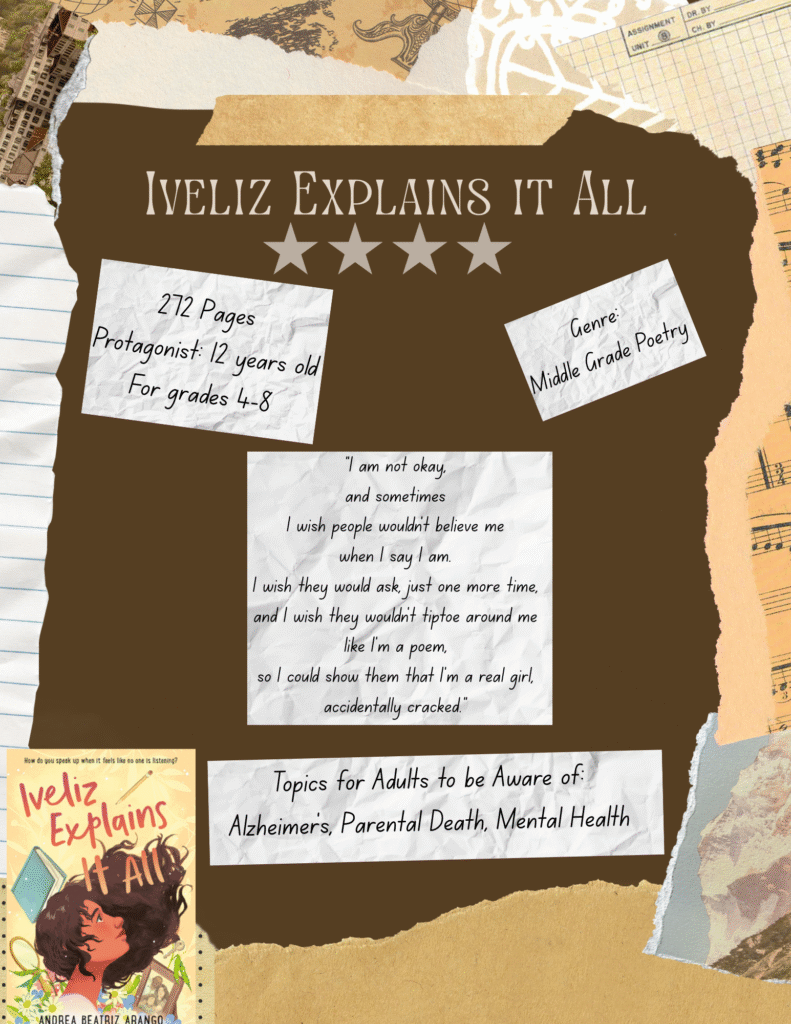
Iveliz Explains It All follows seventh grader Iveliz, a Puerto Rican girl navigating mental health challenges, family tension, and life after trauma. She’s determined that this school year will be different—no trouble at school, no arguments with her mom, and definitely no skipping her medication. But life rarely goes as planned.
Her abuela Mimi has just moved from Puerto Rico and doesn’t believe Iveliz needs medicine at all. Her mom doesn’t seem to understand her feelings, and her classmates can be cruel. Through journal entries and verse, Iveliz begins to share the pain and confusion she’s been carrying and slowly learns that healing isn’t about being “fixed,” but about finding the words to explain it all.
Winner of a Newbery Honor, this novel-in-verse is a powerful, emotional portrait of what it means to live with mental illness, to love imperfectly, and to learn self-advocacy.
What Worked
- An authentic voice – Iveliz’s narration feels raw and real. She’s emotional, funny, impulsive, and hurting, just like many middle schoolers learning how to name what they feel.
- Representation that matters – Arango captures the cultural nuances of being Puerto Rican and the generational divide around mental health and medication. For many Latinx readers, especially those navigating similar family dynamics, this will feel deeply validating.
- Mental health handled with care – The book doesn’t shy away from therapy, trauma, or medication. It shows that healing is not linear and that taking medicine doesn’t make someone weak—it makes them brave.
- Hopeful realism – The ending doesn’t promise that Iveliz is “all better.” Instead, it shows growth, communication, and small victories. It’s honest and hopeful, exactly what kids need.
What Didn’t Work
- Language barrier moments – There’s a lot of untranslated Spanish, which might frustrate some readers. Personally, I liked how it mirrored Iveliz’s mom’s confusion. It puts English-only readers in that same space of not fully understanding, which is powerful.
- Repetition – A few sections circle back to similar emotions or conflicts, but that repetition realistically reflects how mental health struggles often feel in real life.
- Limited context at times – The verse structure beautifully captures emotion, but sometimes I wanted a bit more narrative depth or background detail.
Final Thoughts
Iveliz Explains It All hit me straight in the heart. It’s beautifully written and emotionally honest, a book that could truly help the kids who need it most. For students dealing with anxiety, depression, or trauma, this story says, you’re not alone.
As a former middle school teacher, I kept thinking how much my students, especially those from bilingual or bicultural homes, would see themselves in Iveliz. This book is a gift for readers who are “in between” worlds, learning to use their voices, and trying to make sense of emotions adults sometimes dismiss.
My Rating: 4/5 stars.
A poignant, powerful, and necessary addition to classroom libraries. It’s a book that helps kids see the strength in asking for help and the courage it takes to explain it all.



0 Comments